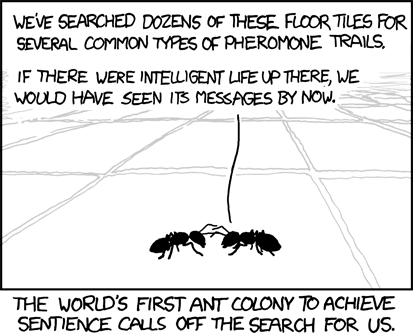
As I read this article I couldn’t help but feel surprised at the conclusions the researchers had reached and the logic they had used for it. The entire argument is based on assumption that what we see here on Earth is what “life” is and the capabilities of human brain are what comprise “intelligence”. How reasonable is such an assumption? In my humble opinion, not at all. It just serves to highlight the egocentrism of us homo sapiens. Studies in various branches of biology in last few decades have uncovered living creatures in conditions that we did not expect to harbour life until then. These are called ‘extremophiles’. The most well known example is probably the whole ecosystem flourishing around the hydrothermal vents on the ocean floors, in either very acidic or alkaline conditions, in total absence of sunlight. And we keep finding more of them thriving under various conditions considered extreme for human beings. So is it logical for the scientists to talk about ‘the Goldilocks region’ mentioned above?24 Dec 2009
Intelligence? Life?
As I read this article I couldn’t help but feel surprised at the conclusions the researchers had reached and the logic they had used for it. The entire argument is based on assumption that what we see here on Earth is what “life” is and the capabilities of human brain are what comprise “intelligence”. How reasonable is such an assumption? In my humble opinion, not at all. It just serves to highlight the egocentrism of us homo sapiens. Studies in various branches of biology in last few decades have uncovered living creatures in conditions that we did not expect to harbour life until then. These are called ‘extremophiles’. The most well known example is probably the whole ecosystem flourishing around the hydrothermal vents on the ocean floors, in either very acidic or alkaline conditions, in total absence of sunlight. And we keep finding more of them thriving under various conditions considered extreme for human beings. So is it logical for the scientists to talk about ‘the Goldilocks region’ mentioned above?22 Oct 2009
Too mundane for space travel?
wn as Nitinol, recently popular for use in dental braces, would have been originally developed by NASA for aerospace uses! This new alloy does not crimp when bent and returns to its original shape as teeth shift! But that's not the only invention that fascinates you with the fact that it was originally invented for space travel. A few days back I came across this article from Radaronline.com that shares with its readers 13 such items that we use in our daily lives which were originally invented for space travel. They range from handheld video cameras to Zen perfume. Check it out!22 Sept 2009
TED Tuesday: Future of SETI
17 Sept 2009
Weirdest cosmological theories
Stephen Battersby of New Scientist gives a primer on the 10 most weird cosmological theories put forward by various individuals over the centuries.- Clashing branes
- Evolving universes
- Superfluid space-time
- Goldilocks universe
- Gravity reaches out
- Cosmic ghost
- It's a small universe
- Fast light
- Sterile neutrinos
Reading through these titles would have probably stoked your curiosity enough to click on the link above and read the whole article.
25 Aug 2009
TED Tuesday: Fly me to Saturn
Carolyn Porco shares exciting new findings from the Cassini spacecraft's recent sweep of one of Saturn's moons, Enceladus. Samples gathered from the moon's icy geysers hint that an ocean under its surface could harbor life.
30 Jul 2009
Hubble sees "bubble"
The "Cygnus Bubble" nebula may actually be a cylinder that is being seen from one of its ends. This image was taken with the Kitt Peak Mayall 4-metre telescope in Arizona (Image: Travis A. Rector/U of Alaska Anchorage/Heidi Schweiker/NOAO)]IT LOOKS like a soap bubble or perhaps even a camera fault, but the image at right is a newly discovered planetary nebula. [...] The bubble, which was officially named PN G75.5+1.7 last week, has been there a while. [...] "It's a beautiful example," says Adam Frank of the University of Rochester, New York. "Spherical ones are very rare." One explanation is that the image is looking down the throat of a typical cylindrical nebula. However, it is still remarkably symmetrical, Frank says.
26 Jul 2009
Sunday Spotlight: The Virtual Telescope

A few days back I got an invite to join a group on LinkedIn. It was called The Virtual Telescope Project, a name that interested me enough to go ahead and check out what was this all about. And once I was on the website, I knew I had to write a Sunday Spotlight on this particular service provided by the Bellatrix Astronomical Observatory.
The homepage beckons you to enter the website with the message, "Enjoy the real Universe from your desktop, live!". It is available in English and Italian. This project/telescope is a participant in the IYA2009 activities. The website is created and directed by Gianluca Masi. Here you will find out what makes Virtual Telescope a unique case in the world. The Virtual Telescope offers live shows and astronomical Labs, in real-time or with archived material (the latter being free).
I am very much looking forward to participate in their next live show on Monday 3rd August, which is in Italian. But ... the fascinating beauty of the deep space is beyond spoken word.
4 Jun 2009
ESA's "Earth suite" spacefracts
[Artist's impression of Goce, image source: ESA] However, European Space Agency's (ESA) launch of Goce gravity mapping satellite in March 2009 marked a beginning of a "geo-centric" space programme. The satellite is part of an armada of European spacecraft being sent up to study the planet. The BBC News reports,
"We have 24 satellites funded and ready to be launched over the next decade; something over a billion [euros] in expenditure per year," said Stephen Briggs, the head of Earth observation science at ESA. "This allows us to take a major role worldwide in providing a global system for the observation of the Earth and for a better understanding of the processes which survive thereon," he told BBC News.
Goce will map the subtle variations in Earth's gravity field
Smos will study ocean salinity and soil moisture
Cryosat-2 is designed to map the Earth's ice cover
Aeolus will use an innovative laser to measure winds
Swarm is a trio of satellites to map the Earth's magnetism
Earthcare will examine the formation and effects of clouds
A.N.Other will emerge from a current selection competition
5 May 2009
Best NASA pictures of the Earth
In this blog post, I just want to share something with you all. No opinions, no thoughts, no debates. Just plain old getting fascinated by the amazing advances we’ve made in space observation and photography and it’s results.NASA's Earth Observatory announced the ten most popular pictures of our home planet from its 'Image of the Day' catalogue on 28th April, the culmination of a user-voted contest marking the tenth anniversary of the observatory's Web site. These pictures range from the picture of Earth as seen from Saturn to the beautiful abstract painting-like patterns made by sea currents and wind in the Bahamas.
Go feast your eyes!
2 May 2009
Animation to the rescue

An excerpt from UCLA Today’s news item ‘Team's re-creation of ancient Karnak brings history of pharaohs to life’ reads, “The result of two years of painstaking research by a team of more than 24 scholars and technicians, Digital Karnak explores how scores of existing ruins may have originally looked and demonstrates how they came to be altered over time as generations of pharaohs put their stamp on the site that served as the religious center for Thebes, the Ancient Egyptian capital during the Golden Age of the Pharaohs.”
This is just one of the numerous examples of the use computer simulation, 3-d modelling and animation has in the scientific research today. These tools have afforded the scientists, from Egyptologists to space researchers, to transcend the barrier of space and time, albeit virtually, and aided the research tremendously. Based on the data already at hand, simulations and animations build a hypothetical image (be it a structure or a flight path) of what could have been or what could be. Having an image or action sequence running in front of one’s eyes is vastly helpful in the areas of research where the scientists haven’t had a chance to be in the place, time or situation they are studying.
Of course animation took its time to reach the sophisticated, 3-d, virtual reality stage that it is in today. The early humans “animated” simple day-to-day scenes by painting a sequence of actions on a vessel which one simply turned to see the “animation”. I’m sure you still remember the ‘flip-books’ when you were in school, pages of which had to be rapidly flipped in order to see a Cricketer play a shot or a soccer player score a goal. That was animation in its good ol’ 2-d form. Even today 2-d animation is useful for simulating the history of World War II or the spread of various religions across the globe. Of course if you are trying to simulate the threat of all the space-junk that orbits around the Earth to a space craft, you need much advanced, 3-d, virtual reality sort of animations.
However, simulations and animations are used mostly for entertainment purpose in our society. Most of it is aimed towards the computer and video games that have zero intellectual-stimulation and high violence-stimulation quotient for the brain. Very few but sensible people use these wonderful tools for edutainment. Someone like Matthew Sweetapple and his Rockford’s Rock Opera tries to educate the children about sustainability and our responsibility towards this planet. Others like the What the bleep?!? team give the viewers some food for thought about whether we really know what we think we know.
3 Apr 2009
... how I wonder what you are!
I was first going to title this blog “twinkle twinkle little star”. But as I repeated the old nursery rhyme to myself I realised the second line more appropriately captured the essence of astronomy; how I wonder what you are! For eons, we humans have looked up in the night sky I wondered about what the little twinkling wonders were. Depending on our level of scientific and technological advancement it could be simply gazing upward with naked eye and trying to join the dots making imaginary creatures or it could be focusing a humongous telescope array on colliding galaxies to learn about how the universe came about. But the heavenly bodies never stop intriguing us. The branch of science that studies the celestial objects is called ‘astronomy’, from the Greek words astron meaning "star" and nomos meaning "law". 2009 has been declared the International year of astronomy (IYA 2009). I have wanted to write about IYA 2009 for a while but today was a good day to do so. The RTR09 campaign for which I’ve been volunteer blogging lately has nothing scheduled for the next three days so it is a good time for me to get back to my science writing. Also, one of the cornerstone projects for IYA 2009, 100 hours of astronomy, began yesterday. This is a worldwide marathon event that goes on for 100 hours straight and astronomers and lovers of astronomy organise and participate in various events around the globe dedicated to astronomy for these 100 hours. A special 24 hour-long webcast is going to be broadcasted that will take you on the tour around the world in 80 telescopes starting 9am UT today. It will include interviews of scientist at these facilities, their overview and some views of what one can see from these on-land and in-orbit telescopes. It starts in about 30 minutes so tune in fast!
28 Mar 2009
Frequent flyer to space?
Another example of the exponential growth of science and technology..... space tourism predicted to be feasible by 2011. When I was a kid (which is about 20 years ago), space travel was seen fit in the plot of a futuristic sci-fi movie. The year used to be 2050 or some such. But definitely not 2011. However, if press reports are anything to go by, short tourist flights into space are expected to begin launching from the US by 2011 and from northern Sweden in 2012. Virgin Galactic, a UK based company operating in US and EU, has test-flown its twin mothership, WhiteKnight Two, on Dec 21, 2008. The spaceship will have two pilots and capacity to carry 6 passengers. They will be able to enjoy the ride to the very edge where Earth’s atmosphere ends and outer space begins. 12 Mar 2009
Is humanity a space-faring race?
A well-written article by Seth Shostak on the SETI Institute website asks the question in the title of this blog. And also suggests an interesting answer. Humanity has always had an ambition and fantasy to explore the galaxy in elaborate spaceships as shown by the popularity of TV shows like Star Wars, Battlestar Galactica, The Enterprise to name only a few. However this article takes a different view based on the scientific and technological progress we have made in last few decades. In the author’s own words, “..... in seven decades our rockets sped up by a factor of ten, but in little more than half that time our cameras improved by a factor of five thousand. There's no comparison: probe technology is marching to the beat of a faster drummer.” The author therefore suggests that while we might explore our solar system using manned space shuttle missions, space probes offer a much low risk and high efficiency option for deep-space research. So, may be, humans will not zoom around in their inter-galactic spaceships afterall, getting “beamed up” from one galaxy to another!7 Mar 2009
Looking outwards..... and inwards
The other one points inwards. Eckhart Tolle's well-acclaimed and appriciated book, Power of Now, that takes one on a journey within themselves to understand the purpose of life. This books has been around for a few years now but I bought and read it today for the first time. And I just found out that by amazing coincidence, Eckhart was giving a lecture today in Sydney, which I was completely unaware of. But somehow I got inspired to look for his book only today!
22 Feb 2009
Earth's diamond ring
We have seen a Solar eclipse from Earth many times as the Moon blocks the view of Sun and the diamond ring effect that is caused due to roughness (craters) of the lunar surface. But recently, Japanese lunar orbiter, Kaguya, caught the spectacular Solar eclipse from the Moon's perspective, while Earth blocked the Sun!
Take a look at the video and pictures. It looks very similar to the Solar eclipses we see from Earth but the idea of seeing our own planet causing the eclipse is what I find fascinating :).
14 Feb 2009
It’s a bird, it’s a plane, it’s SPACE-JUNK!
A privately owned U.S. Iridium satellite collided with the Russian military's defunct Cosmos 2251 satellite over northern Siberia on Tuesday just before noon, US Eastern Time. The two satellites were travelling at about six miles (ten kilometres) a second when they collided. This collision added more than 500 bits of debris to the roughly 18,000 pieces of known space junk orbiting Earth already. A video on New Scientist’s YT channel shares a simulation made by Analytical Graphics that shows the possible path of the new debris around Earth amongst the existing ones.
According to the article on National Geographic’s (NatGeo) website, most of the larger debris is kept track of by various space agencies but some smaller ones that are not tracked can be equally threatening doe to their high velocity. The write up on the New Scientist website concerns the possibility of predicting such collisions and, therefore, avoiding them. On a lighter note, Wired Science shares a list of some weird space-junk items left behind. Although the danger to the International Space Station caused by floating debris of the latest collision is minimal, it has sparked a discussion and review of whether we are overcrowding the space around our planet.
I, therefore, thought of sharing another article on NatGeo’s website that gives a nice overview of the space-race that the mankind is engaged in. This overview tells us that, “There are 8000 artificial objects orbiting Earth. More than 2,500 of these are satellites, working and dead. The remaining objects are space-junk (technically known as orbital debris).” This page also has an interactive feature that gives information about the types of satellites and details of some notable satellites such as Hubble telescope, Voyager space probes etc.
6 Feb 2009
The solar system and beyond
Two very interesting articles came to my attention last week, one about our solar system and the other about the deep space beyond. The article published on the New Scientist website is titled “Our unknown solar system”. It is kind of a compilation of six other articles that appear on the same website. Each of these six articles focuses on one aspect of the solar system that is still a mystery to the humanity.
The first article, How was the solar system built?, gives an insight into the birth of our solar system and of course about the things we do not know certainly about the solar system. The second, Why are the sun and moon the same size in the sky?, talks about eclipses. In the beginning it seemed a little weird to me that this should be a subject of an article. The explanation is too straight forward; the Sun is 400 times larger than the Moon but also 400 times farther. But as I went on to read the article, it became clear that the article focused on the possibility that this might not be a mere coincidence and how the size of the Moon might be responsible for origin of life on Earth. Is there a Planet X? is the third article in the series which, as the title suggests, explores the possibility of an as yet unknown planet on the outskirts of our solar system. The next article, Where do comets come from?, was a bit of a surprise for me as I had thought the astronomers knew the answer to this question. Along with listing what we do not know about the comets, it also gives nice overview of different types of comets and the reasons why it is difficult to spot and study them. The fifth in series is, Is the solar system unique?, which tackles the question in the title and the possibility of the answer being “no” is increasing along with our knowledge of the Universe around us. And lastly, How will the solar system end?, delves into the still-far-into-the-future event of the end of our solar system.
The other article is a contribution by John Roach to the MSNBC website. It talks about the project “From Earth to the Universe” which is one of the several projects organized to mark the International Year of Astronomy (IYA 09). More than 40 countries have agreed to participate in this project and have made 125 images from their respective space agencies for display around the world, in public places like the airports, parks etc. The article shares 10 of these images along with little information snippets about them. It makes a great read for anyone interested in mesmerising images from the outer space, which I think is most of us.
16 Nov 2008
Indian impact probe lands on moon

Chandrayaan is the cheapest lunar probe and it has as its payload 14 (the highest number to be carried at one time) different instruments from different countries. India has become the first country to have made a lunar probe to have succeeded as an orbiter and a lander on its MAIDEN mission!
Proud to be an Indian! :)
24 Oct 2008
Hubble - Secrets from space
This is part 1 of 7 part series on YouTube which talks about and shows us how the Hubble space telescope came about and what the humankind has achieved by accomplishing this hugely creditable feat. A must watch for any astronomy/space/science-lover!