Showing posts with label evolution. Show all posts

24 Dec 2009

Intelligence? Life?

A recent article on PhysOrg.com by Clara Moskowitz of Astrobio.net reports on a new study that has found that the most probable place to find intelligent life in the galaxy is around stars very similar to our own sun. The researchers involved in this study talk about a Goldilocks region around a star in which a planet would be just right for life - not too close that its surface would be boiling, and not too far that it would be frigid either. The article goes on to say, “Indeed, sun-like stars seem to have the right balance: They are of high enough mass that they are more likely to host habitable planets, but they are of low enough mass that they live long enough for intelligent life to develop, and are not extremely scarce.”

As I read this article I couldn’t help but feel surprised at the conclusions the researchers had reached and the logic they had used for it. The entire argument is based on assumption that what we see here on Earth is what “life” is and the capabilities of human brain are what comprise “intelligence”. How reasonable is such an assumption? In my humble opinion, not at all. It just serves to highlight the egocentrism of us homo sapiens. Studies in various branches of biology in last few decades have uncovered living creatures in conditions that we did not expect to harbour life until then. These are called ‘extremophiles’. The most well known example is probably the whole ecosystem flourishing around the hydrothermal vents on the ocean floors, in either very acidic or alkaline conditions, in total absence of sunlight. And we keep finding more of them thriving under various conditions considered extreme for human beings. So is it logical for the scientists to talk about ‘the Goldilocks region’ mentioned above?

Slightly more difficult to refute is the definition of “intelligence”. Because it is hard to imagine what else, other than what we do, could be called intelligent. But I think it is easier if we consider the “signs of intelligence” that we look for rather than intelligence itself. And that’s how we have been looking for extraterrestrial intelligence so far. Can we detect any electromagnetic signals? Can we see any organised structures on other planets that don’t look natural? But who is to say that life forms with completely different physical structure to us and living on a planet that not necessarily has similar elemental composition as Earth and its atmosphere are to “progress” in a way recognisable to humans? We have various electronic devices transmitting signals because we have plenty of silicon. We have built the machines and structures we have because that’s what we could do with our 2 hands, 2 legs, one brain bodies. Our languages developed like they did because of the way our vocal organs evolved. If we take movies like Men in black seriously for a second, it is easy to see how any of those weird looking aliens could probably not achieve the same feats. All the ET themed movies so far are a bit misleading in the sense that they show the ETs coming to Earth in their own physical forms, different from ours. But they seem to be perfectly alright in the Earth’s atmosphere, breathing our air, walking comfortably under the influence of Earth’s gravitational field. So once again, the assumption is the conditions “back home” for them are the same. I think what was shown in the movie The day the Earth stood still is more logical. The aliens gather our DNA sample, make a placental tissue to encase themselves in during their journey to Earth and then “be born here on Earth” to be physically identical to homo sapiens.

[Image source here]
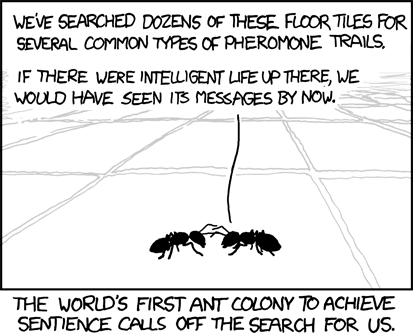
Do you not think there is a chance that we have not recognised other intelligent life because we are looking for what is familiar to us? May be their buildings don’t look like ours. May be they don’t communicate using a form of energy (electromagnetic) that we can detect. And may be it is the same for them that they can’t recognise Earth as a planet inhabited by “intelligent” “life” because they’re looking for something completely different to homo sapiens. So is the universe designed such that all intelligent life forms remain isolated from each other? Or will we progress to a stage where we will find something that pervades all substance (living or non-living by our definition) of the universe?


17 Dec 2009

Big brother ... REAL BIG!!!


Yeah, I know ... try and close your mouth now. That picture above would have given you a pretty good idea of what's coming. Science reporter Rebecca Morell of BBC News reports about the colossal sea monster, Pliosaur, whose fossilised skull has been unearthed along the UK's Jurassic Coast by a local collector. In the video on the webpage (which I could not embed here) Palaeontologist Richard Forrest explains why the T. rex was a kitten compared with this monster.
Richard Forrest, a plesiosaur expert, said: "Pliosaur skulls are very big, but not that robust, in general, and you tend to find them crushed flat - completely 'pancaked'. "What is fantastic about this new skull, not only is it absolutely enormous, but it is pretty much in 3D and not much distorted."
Pliosaur means 'more like lizard' and are characterised by having a short neck and an elongated head, in contrast to the long-necked plesiosaurs. Pliosaur fossils have been found before around Norway, Mexico etc. But this find in the UK is by far the largest specimen yet found. If the pictures above and the description has still not convinced you to click on the link in the first paragraph and go watch the video, may be this will.
"It could have taken a human in one gulp; in fact, something like a T. Rex would have been breakfast for a beast like this."


Reblog this post [with Zemanta]

10 Dec 2009

Pushing it back

This is a short post sharing two stories of latest archaeological discoveries that are once again pushing back the dates of the advent of “civilised” humans.

National Oceanography Centre, Southampton (UK) reports on EurekaAlert of Pavlopetri -- the world's oldest known submerged town.

The world's oldest known submerged town has been revealed through the discovery of late Neolithic pottery. The finds were made during an archaeological survey of Pavlopetri, off the southern Laconia coast of Greece. Marine geo-archaeologist Dr Nic Flemming of the National Oceanography Centre, Southampton said: "The discovery of Neolithic pottery is incredible! It means that we are looking at a port city which may be 5000-6000 years old, with trade goods and wrecks nearby showing some of the very earliest days of seafaring trade in the Mediterranean." [...]"What we've got here is something which is two or even three thousand years older than most of the submerged cities which have been studied," said Flemming: "And it is uniquely complete. We have almost the complete town plan, the main streets and all of the domestic buildings. "
William G. Gilroy writes in ScienceDaily, based on materials provided by University of Notre Dame, about how World's Oldest Known Granaries Predate Agriculture.

A new study co-authored by Ian Kuijt, associate professor of anthropology at the University of Notre Dame, describes recent excavations in Jordan that reveal evidence of the world's oldest know granaries. [...]However, in a paper appearing in the June 23 edition of the Proceedings of the National Academies of Sciences, Kuijt and Bill Finlayson, director, Council for British Research in the Levant, describe recent excavations at Dhra' near the Dead Sea in Jordan that provide evidence of granaries that precede the emergence of fully domesticated plants and large-scale sedentary communities by at least 1,000 years.
These kinds of discoveries keep scientists on their toes, rethinking the flow of history and pre-history. Some day perhaps the concept of Yuga cycles and that of advanced knowledge that ancients possessed will be vindicated through such discoveries.
Reblog this post [with Zemanta]

29 Oct 2009

Meet the super cow

I'm not sure what my reaction about this video is. It is one more of those instances where humans have used their scientific know how to manipulate the nature to their advantage. Selective breeding is used to produce these hugely muscular cows and bulls, weighing sometimes up to 1 tonne (ton). There is no cruelty to the animals involved here but even so, I couldn't help but cringe a bit looking at these bovines.


Reblog this post [with Zemanta]

27 Oct 2009

TED Tuesday: Aquatic ape theory

Elaine Morgan is a tenacious proponent of the aquatic ape hypothesis: the idea that humans evolved from primate ancestors who dwelt in watery habitats. Hear her spirited defense of the idea -- and her theory on why mainstream science doesn't take it seriously.

Reblog this post [with Zemanta]

6 Oct 2009

TED Tuesday: Engineering and evolution

Insects and animals have evolved some amazing skills -- but, as Robert Full notes, many animals are actually over-engineered. The trick is to copy only what's necessary. He shows how human engineers can learn from animals' tricks.

Reblog this post [with Zemanta]

6 Aug 2009

10 Strange Species Discovered Last Year

Alexis Madrigal of Wired Science shares with us the 10 Strange Species Discovered Last Year, the article that tells us,

Every year, biologists brave the world’s deserts, jungles and industrial ecosystems looking for new species. And what wonderful things they find. It turns out that the real world is totally like the internet: If you look hard enough, you can find just about anything. This year, scientists found caffeine-less coffee plants, tiny seahorses and a 23-inch long bug that looks like a branch, not to mention a strange white slug no one had ever described that was found in a Welsh garden.
Below, you’ll find the top 10 species found and described in 2008, according to The International Institute for Species Exploration at Arizona State University.

Read it, see them and be amazed!
Reblog this post [with Zemanta]

4 Aug 2009

TED Tuesday: Our "queer" Universe

Biologist Richard Dawkins makes a case for "thinking the improbable" by looking at how the human frame of reference limits our understanding of the universe.


16 Jul 2009

Of midgets and giants


I didn't know that in island environments small mammals (e.g. rodents) tend to evolve to be larger (Island gigantism), and large mammals (e.g. elephants) tend to evolve to be smaller (Island dwarfism). This is not considered to be evolutionary trend by some due to the fact that different parameters apply in an isolated island environment. Wikipedia telle me that J. Bristol Foster published his work in 1964, now known as 'Island rule', in which he suggested the simple explanation that smaller creatures get larger in the absence of the predators they had attracted on the mainland and larger creatures become smaller with the absence of food sources. An article in Science Daily suggests, however, that the original size of the species was said to be the key determining factor in these changes. And that the new research by a group in Imperial College London have shown that "bigger becoming smaller and vice versa" is not always the case and varies depending on each islan's environment.

Interestingly, recent research in marine biology led by MBARI postdoctoral fellow Craig McClain suggests that a similar trend affects animals as they adapt to life in the deep sea. However, once again the trends are not uniform from species to species and the causes are not very clear either. So in general, it looks like we've still got quite a bit to learn about our fellow Earthlings in isolated environments.
Reblog this post [with Zemanta]

14 Jul 2009

TED Tuesday: Underwater astonishments

David Gallo shows jaw-dropping footage of amazing sea creatures, including a color-shifting cuttlefish, a perfectly camouflaged octopus, and a Times Square's worth of neon light displays from fish who live in the blackest depths of the ocean.


With vibrant video clips captured by submarines, David Gallo takes us to some of Earth's darkest, most violent, toxic and beautiful habitats, the valleys and volcanic ridges of the oceans' depths, where life is bizarre, resilient and shockingly abundant.


26 May 2009

TED Tuesday: Homo Evolutis


..... the species that takes control of the evolution of his/her own species ..... and the others'.

This 17.5 minute talk by Juan Enriquez is another of the fascinating ones from the TED talks. The idea of how our species could evolve in near future is mind-boggling. The ability of our descendents to see, hear and talk would cover a much wider range of light and sound spectrum. They would have all the sensory capabilities of all the other creatures on this planet that fascinate us today. And may be, there would be no other species left on this planet either .....

18 Apr 2009

Sunday Spotlight: Letters from 2030 and A J Gerst

A few weeks back while randomly surfing from one blog to another, I came upon a very interestingly futuristic blog (which I now follow). It is a fictional look at the world after an abrupt climate change, which is a very realistic possibility for our generation. Eco writers and activists Bob Williamson from Australia and Anthony J Gerst from Iowa, USA are jointly working on a fictional book Letters from 2030 and some excerpts are published on their blog by the same name. The very first post on the blog, titled ‘January 2030. A call to hope.’, starts out vividly describing the polluted and dissolute world of future .....

“He stood looking down on the once busy city streets. The sky is dull even though long ago the pollution for the coal fired power stations that pumped electricity to the dependant urban population have ceased to emit their deadly carbon dioxide. He remembered the promises of the pro-coal lobby and the politicians back in the first decade of the 21st century. ‘We can continue with business as usual – we are investing in clean coal technology and carbon capture and storage’ He researched this in depth back in those days and tried to alert people to the absurdity of their claims. The streets below are now deserted, long since flooded by rising sea levels. The assurances of the science community that the risks of sea level rises of several inches by 2100 now in 2030 seemed like a science and political conspiracy. As they waited during those years to present their peer reviewed verifiable reports to policy makers based on observed outcomes of climate change; climate change didn’t wait with the same patience.”

The tone is set for the blog (and the book) very effectively and reader can’t help but read on, from one post to another. I very much enjoy my read of these “letters from 2030”.

Bob Williamson is the founder and Chair of the Greenhouse Neutral Foundation and the author of ZERO Greenhouse Emissions - The Day the Lights Went Out - Our Future World, published by Strategic Book Publishing New York. Anthony J Gerst is a writer and an eco-warrior who is a columnist for the Galesburg Zephyr, an independent newspaper in Illinois. He also belongs to the Care 2 Connect society, a rather substantial online activist site. I thought of sharing (with his permission) his April column from the Galesburg Zephyr, which explores the possibility of accelerated evolution of organisms in face of sudden and abrupt climate changes.

“Climate Mind Shifts:
I belong to the Care 2 Connect society, a rather substantial online activist site. The other day I was reading their quote of the day. It was from a Swedish botanist; the jest of it was nature does not move forward in leaps and bounds. Really! The problem with the scientific community is the double edge sword of their existence, the scientific method.
The scientific method and the U.S. Senate have a lot in common. They both move via a tradition of acceptance based upon linguistical bombast and societal acceptance. Grant it, one deals with norms and mores, primarily, while the other deals with testing and quantifying across multiple disciplines. My primary problem with this is that climate changing events are still accelerating at an exponential rate. Mankind is destined to still be debating in the full flourish of their oratorical skills against the premise of anthropogenic warming, while the maddening onrush of abrupt climate change transforms the ecosystem beyond his doorstep. Now, back to my little
friend, Swedish style.
Science has not proven evolution beyond theory. I am a full believer in this, but they have failed to show any evidence of it occurring as we live and breathe. They claim the process happens so slowly that we cannot see it. While they may be right, they may be wrong. So let’s propose another concept on the premise of evolution today. It is now becoming a very well accepted idea among the scientific community that abrupt climate change has occurred often in the planet’s history. Be it caused from an extraterrestrial impact, rapid tectonic plate shifts, our current anthropogenic activity, dominant species resource taxation or nova orbital eclipses, abrupt climate change is interwoven into the fabric of Gaia’s cyclical patterns.
It is now speculated that the Amazon rainforest if we continue on our current consumeristic consumptive path, will reach a tipping point when the entire system crashes within a 10-15 year period, then transforms itself into a savanna. During these times of abrupt climate change, one thing is clear, extinction rates for the higher life forms leave holes in the evolutionary window. Today’s theory then is a simple one. When an entire ecosystem like the rainforest can crash and reestablish itself anew within a 30-100 year time frame, does it not make sense that lower fauna with shorter generational life expectancies go through an increased biological transformation to match the flora? Could not the natural system of Gaia offer an accelerated window of evolution when the planet’s entire ecosystem is in flux? And stabilizing throughout an epoch until the next planetary ecosystem shift occurs.”


This was a good time to share this article as my blog poll this week asked my readers whether they felt “Evolution is still a valid theory?” The majority have answered ‘Yes’, which reflects the popular opinion. However, there are a few people (increasing in numbers) that have their doubts. And I’m curious to know who was the second person who voted ‘Not applicable to modern humans’ on the poll ... the first was yours truly! :)

Reblog this post [with Zemanta]

25 Mar 2009

Look, a pink elephant! For real!!!

[Image source: original BBC News article]
Albinism is a hypopigmentary disorder characterised by partial or complete lack of melanin pigment in the eyes, skin and hair (or more rarely the eyes alone). It is found in humans as well as various animals such as penguines, wallabies, turtles and alligators to name a few. However, an albino African elephant is extremely rare find. But BBC cameraman Mike Holding, who spotted a baby albino elephant while filming for a BBC wildlife programme, said: "We only saw it for a couple of minutes as the herd crossed the river." The team is unsure of its chances of long-term survival; the blazing African sunlight may cause blindness and skin problems for the calf. The skin colour of the calf is more of pink than white.
Reblog this post [with Zemanta]

27 Feb 2009

Extreme conditions, extreme response

[Image source: supplementary material for the paper published on Nature website.]

An article on Physorg.com that I thought was worth sharing reports the new findings in the field of cell multiplication that could provide another window to look at the origins of life. “All living cells on the planet go through the process of division in order to survive and thrive. Cell division, or binary fission, allows one cell to split down the middle to become two cells.

In the work published in Nature, Newcastle University scientists have found that under some conditions, including treatment with antibiotics, common bacteria switch to a whole new way of increasing in number that may have been used by the first cells to evolve on the planet.” The research carried out by Newcastle University team led by Professor Jeff Errington have seen the bacteria forced to live without their cell wall multiply by “squirting out babies”, as many as 5 at a time! Extreme conditions call for extreme response.

These results have also lead the researchers to believe that this mechanism should be considered as an alternative when investigating the origins of life on Earth. The conditions on this planet were quite extreme when the life made its first appearance.


Reblog this post [with Zemanta]

24 Feb 2009

200 years on: Darwin AND Design?


‘Unlocking the mystery of life’ is a documentary produced and distributed by Illustra Media describes Intelligent Design (ID) as an extension of evolution, not a substitute. Yes, I know most of you will cringe at the mention of ID due to the tarnished reputation it has received lately. ID has been, unfortunately, used my religious establishments as a proof of existence of God and thus to increase their stronghold on public conscience. The idea of ID was made more famous by the public dispute between the board of a public school in US and the parents who went to court against ID being included in the syllabus of the school. For 200 years now we have accepted Darwinian Theory of natural selection and evolution as a norm. However, evolution talks about how natural selection could have modified existing primitive organisms to produce diverse and more complex species we see today. But it doesn’t explain how life would have originated on this planet.

‘Unlocking the mystery of life’ shows us that natural selection cannot explain complex structures of simple life forms like cell and bacteria or correct assembly of amino acids into functional proteins. It proves (with much success) why intelligent design is required to be considered when explaining the workings a bacterial flagellum or that of protein-assembly using the genetic code stored in the DNA of every living being. Instead of looking at ID as a proof of God’s existence (and hence, dismissing it), it should be looked at as the conclusion to which unbiased scientific observations lead. It should be looked at as (and IT IS) a pursuit of truth about the origin of life. As a couple of scientists mention at the end of this documentary, if the conclusion has religious or metaphysical implications, then so be it! You go where the data leads you.

I believe that after watching this documentary you will remember your high school biology class. When you were taught about the workings of the DNA, mRNA and production of proteins using the counter-sequence encoded in the DNA strand, you were amazed by the precision. And somewhere inside you knew that this had to be “engineered”, it had to be “designed”. You just didn’t know that it was called ‘Intelligent design’.

The evolution doesn’t need to be discarded. But it needs to be used only to explain what it is meant to explain.

3 Jan 2009

Why life originated (and why it continues)?

"Why Life Originated (And Why it Continues)

(PhysOrg.com) -- Today, scientists understand pretty well how life evolves, by mechanisms based on Darwin’s theory of natural selection for survival of the fittest. However, Darwin’s 1859 classic, On the Origin of Species, somewhat ironically doesn’t answer that very question – how species actually originated. And to this day, how that first tiny pool of chemicals twitched to life remains a puzzle."

This interesting article shares with us recent research and a theory based on it put forth by a father-son duo Erkki Annila of the Finnish Forest Research Institute and Arto Annila of the University of Helsinki, that offers some insight into the general driving force of life’s origins in terms of thermodynamics. And makes the quest for the origin of life seem a futile endeavor. According to their theory, all chemical reactions follow the basic laws of thermodynamics and there can be no distinction between the reactions that cause life and the others. All molecules keep reacting till they reach the state of least free energy and most entropy. When reacting in this manner, some chemical reactions lead to complex enough "entities" that can be called "alive".

For more, read their original publication Annila, Arto and Annila, Erkki. “Why did life emerge?” International Journal of Astrobiology 7 (3 & 4 ): 293-300 (2008).


Reblog this post [with Zemanta]

21 Dec 2008

Living fossils

I've been contemplating writing a blog entry for days now. However, I do not like write something just for the sake of it. Currently I'm travelling for work as well as vacation and not necessarily get an Internet connection as well as time enough for me to come up with something I will be satisfied about sharing with you all. I have found a few interesting articles as well as videos that I want to dedicate one blog entry each. But I think its best done once I'm back in my comfort zone and can produce some quality blogs.
For now, I'm going to share a well-researched and well-written article from Wired Science that tells us about "living fossils". These are the earthly creatures that haven't changed a bit since the time they first made their appearance on Earth, which is millions of years ago in most cases. They have somehow managed to escape both evolution and extinction, which makes them quite unique. Since this article itself has links in it for us to read more about each of the creatures if we feel so inclined, I'm not going to go into those details myself. But I found this article very amusing and informative at the same time. I feel everyone should have a read!
Reblog this post [with Zemanta]

3 Dec 2008

Incredible biodiversity in the Antartctic


I found this video interesting! The number of animal species in the Antarctica, a region with extreme conditions, is more than that found on the comfotable Galapagos environment. And the species are pretty diverse and colourful as well, not at all like its monochrome environment.

Reblog this post [with Zemanta]

9 Nov 2008

The Enchanted Isles: Galapagos


A truely enchanting video :). The creatures on this group of isles are as strange as they are beautiful! However, so are those on the Antarctica in spite of their monochrome and adverse environment.
Reblog this post [with Zemanta]

7 Oct 2008

Forbidden Archaeology

Links to the video series, Mysterious Origins Of Man - Forbidden Archeology:
Part 1, Part 2, Part 3, Part 4, Part 5
I am not an archaeologist but I do have tremendous interest in the field. Infact its my dream to be a part of an archaeological project albeit it would be in a capacity of a radiochemist. So understandably I have and still do read a lot of litrature on the subject, whose subject matter varies from paleoarchaeology to egyptology.
Recently I came accross some videos (links above) on YouTube (recorded quite a few years ago) that talk about a book written in 1993 by Michael Cremo and Richard Thompson. The book, Forbidden Archaeology, quickly became an underground classic. Today it is a bestseller, with foreign editions in over a dozen languages. It presents both accepted and anomalous scientific evidence defying traditional ideas concerning human evolution.

As much as Darwinian theory of evolution has been upheld by the majority of scientists, it always has been a subject of controversy. Especially so when it comes to proving that humans evolved from primates. And today absence of evidence has been acknowledged and given the name "missing link", a creature that connects primates to humans, an evolutionary middle stage. So is it possible then that humans originated and evolved on this planet in a different way? Is it possible that we have climbed this ladder from being a hunter-gatherer to the technologically advanced human more than once? And everytime we either are dislodged from this pinnacle by our own deeds or by nature? I believe that life on this planet has gone on in cycles and that we are not the first advanced human civilisation on the face of this planet. The book mentioned above and the the series of videos tries to tell us precisely this.....and shows us the evidence to prove it! Now its left to us whether we want to believe it or not.

In the video, Richard Thompson mentions that there has always been a "knowledge filter" in all branches of science. And the general public gets to know only what has passed through this filter and not the actual knowledge. Graham Hancock, an investigative journalist says "Humans are a species with amnesia. We have forgotten something very important about our past. But our civilisation is not the apex of advances made by human beings."

There is much I could go on writing about the material presented in the videos and the book. But I leave it to you to watch, read, hear, think and form your own opinion. The only question I would like to ask: Does one throw away the remaining pieces of jigsaw puzzle because the (partial) picture created is what one likes? Or should one strive on till one uses up ALL the pieces and is therefore sure that the picture is REALLY complete?


Reblog this post [with Zemanta]